How Is AI Search Changing Digital Marketing in India?
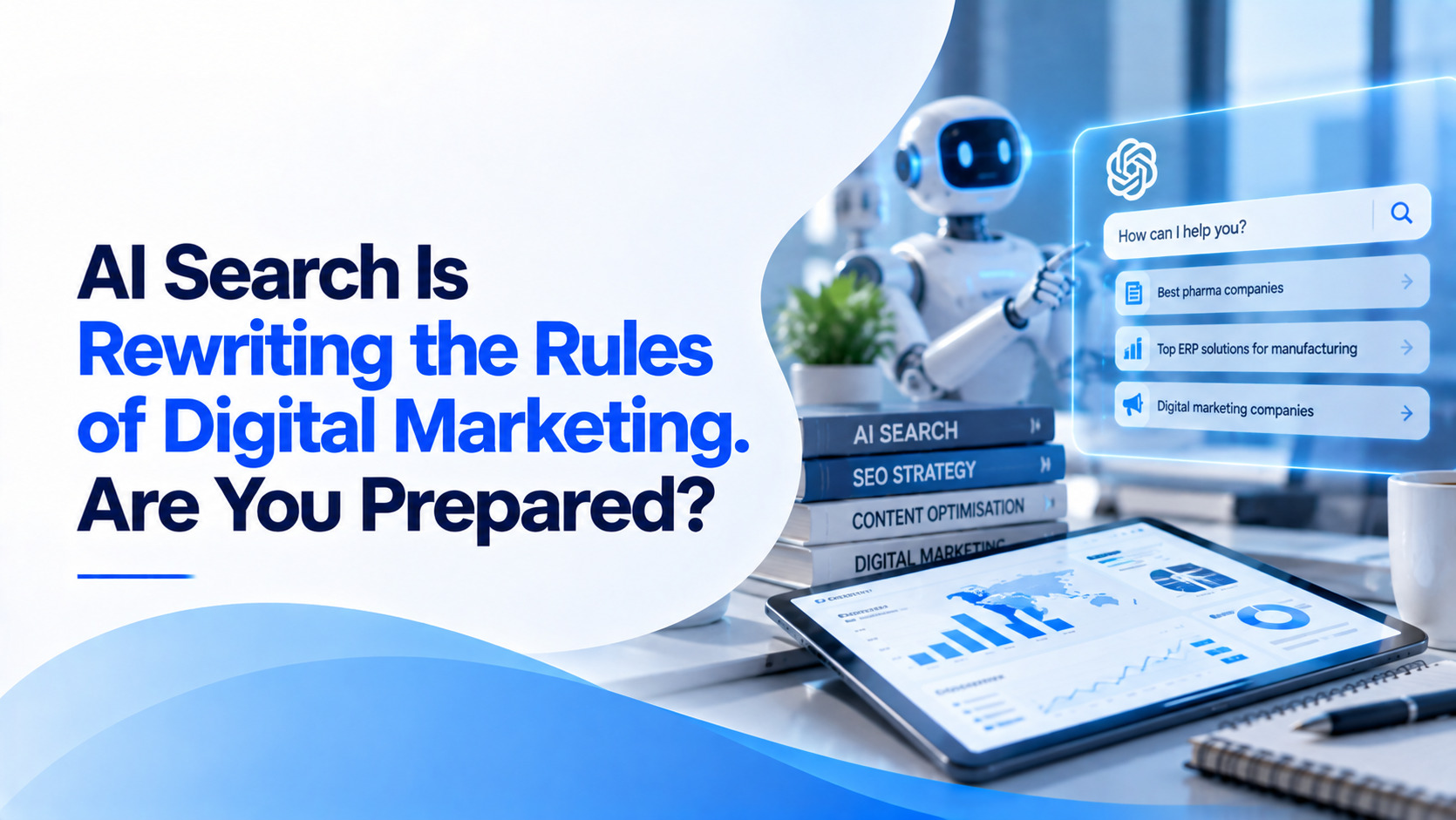
AI search is moving India’s digital marketing from page ranking to getting quoted in answers. Google’s AI Overviews and AI Mode, ChatGPT, Gemini, and Perplexity all summarize information before the user even clicks on it. As such, marketers need to structure their information, data, and reputation in a way that is trusted by artificial intelligence algorithms.
Ask a bunch of Indian CMOs where their buyers search, and most of them will still tell you that it’s Google. And yes, it is Google, but not the one it was in June 2025, when Indian users got access to Google AI Mode, where people were typing questions two to three times more than usual. In fact, by February 2026, ChatGPT reached 100 million weekly active users in India. Google search is gradually converting into a conversation mode, and this is going to be a huge change in digital marketing.
What’s exactly happening?
- Rankings to citations
Page one ranking was the thing before. Now the first thing users see is an AI-generated summary. If your brand is not part of the information sources cited in that summary, you can still rank high but go unnoticed.
- From keyword research to conversations
Indian users ask complete questions, mostly verbally and sometimes even in multiple languages. Content made for short keywords fails to satisfy those queries.
- From website visits to intent
There is less clicking through to a website since the answer is right there in the search result itself. However, the clicks that come are more informed visitors. Reporting needs to move from sessions to informed queries.
- From website SEO to overall footprint
The AI bots create an impression of your brand based on reviews, directories, press releases, LinkedIn, knowledge bases, and your own content. Mismatched information anywhere damages your reputation everywhere.
- From organic only to organic and paid
As ChatGPT Ads start coming to India, paid promotions are being incorporated into the AI experience as well. Credibility in organic results enhances those ads.
Take a quick test
Ask the AI search engines (ChatGPT, Gemini, Google AI, etc.) a basic question: “Who are the leading [your industry] companies in India. Then take note of three vital things:
- Your presence: are you being cited in the answer?
- If you are being cited, then check the accuracy of your description
- The sources that quoted the company names.
– This will serve as your AI visibility baseline.
What does an AI SEO service really mean?
A reliable AI SEO service leverages traditional SEO methods and not vice versa. The basics are:
- Access to technical information to allow AI crawlers to visit and parse your website pages.
- Answer-first content, which is a page that presents the answer first and then supports it with proofs.
- Structured data describing your organization, its services, personnel, and FAQs.
- Insights unique to your firm – your own data, frameworks, and results that AI values due to their uniqueness.
- Consistency of your entities’ presentation on all available platforms.
- E-E-A-T signals: named experts, credentials, and their experience.
- AI visibility monitoring of mentions, citation share, and sentiment evolution.
AI SEO implies applying artificial intelligence internally for analysis of query patterns, clustering of topics, and content gap detection faster than it would take in traditional SEO.
How can you identify the right AEO agency for your business?
In our opinion, the right AEO agency for your business will be the one who will not make big promises at the very 1st instance. As there is no control over what an AI model says, do not listen to anyone promising ChatGPT mentions. Rather, check:
- There is a methodology rather than a set of techniques.
- The agency’s visibility in the AI responses.
- The use of baseline-and-tracking with metrics.
- The integration with your SEO, content, PR, and paid media.
How TechShu helps Indian businesses adapt
At TechShu, we created AEO, GEO, and LLM SEO as part of New Age SEO, which is now incorporated in DMFlow, a 61-step methodology. Over 17+ years, we have worked with the biggest brands globally, and we have seen several algorithm changes in search. This one values everything else: clarity, evidence, and consistency.
We help you build them intentionally, then co-own the KPIs showing that these are working.
Get to know how AI search sees your brand right now. Connect with our team, and we will present you with an AI visibility audit for you to analyse where does your business stands currently in terms of visibility on AI search platforms.
FAQs
What is Answer Engine Optimization (AEO)?
AEO arranges the content and branding of a business in such a way that artificial intelligence applications like Google AI Overviews, ChatGPT, and Perplexity are able to find, rely on, and cite it in their answers.
Is doing SEO still relevant for businesses as on today?
Absolutely. The artificial intelligence algorithms rely a lot on structured and authoritative online content, which is what AEO is built upon.
How soon can the results be seen after AEO?
The results should be visible in the form of increase in accuracy and mentions within a few months. It takes at least 6 months for a consistent citation share.
Can the agency assure us that our brand would be mentioned in ChatGPT?
No, as the AI responses are different every time and the agency cannot control them. However, they can increase the chances of being cited.
How would we be able to know our AI search visibility?
We can measure brand references, citation share against other brands, accuracy of the description, and AI-referenced traffic/enquiries.